
A Clearer Way to Explore ITIL: New Resources and an Interactive Qualification Scheme

Where do I start with ITIL (Version 5)? Does my ITIL 4 certification still count? Which class will help me the most? Which course leads to the designation I want?

These are practical questions, and the answers depend on where you are today and what you want to do next. That is why we keep expanding ITSM Academy’s All Things ITIL resources - to help professionals and training planners find clear information and make confident decisions.

The collection brings together ITIL (Version 5) guidance, certification FAQs, course information, and focused breakdowns of topics such as the Managing Professional, Strategic Leader, and Master pathways. 

New: Explore the Qualification Scheme for Yourself

Our latest addition is our unique, interactive ITIL (Version 5) Qualification Scheme.
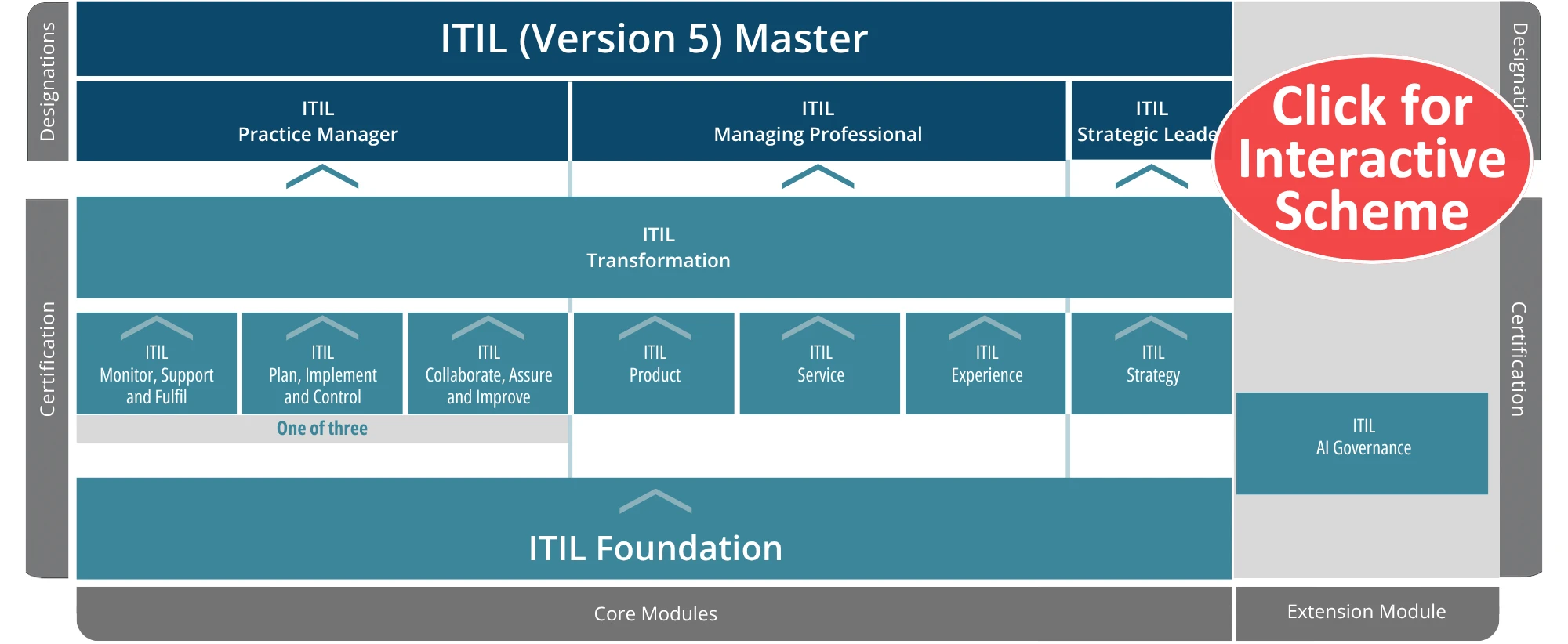
A qualification diagram shows how the pieces connect. Our tool lets you go much further. Select a course or designation to see what it covers, where it sits in the scheme, its prerequisites, and links to learn more. You can also focus the view on pathways such as Practice Manager, Managing Professional, and Strategic Leader.

Two Quick Ways to Find Your Next Step

If you are planning your own development, you can find your best ITIL path by answering three quick questions to identify the ITIL certification path that best fits your experience, professional interests, and goals. Select one answer for each question to see your recommendation. Take the quiz now.

Planning ITIL (Version 5) training for your team? Assess your organization’s readiness for AI-enabled product and service management, stronger operating models, and improved resilience, then identify where your team should focus. Take the ITIL 5 readiness assessment. Your score and recommendation appear immediately after submission.

Resources for the Questions That Come Next

A recommendation is a starting point. You may also want to understand how a designation is earned, what a module covers, or how continuing professional development works. Our All Things ITIL page gathers resources for those questions, including the ITIL (Version 5) Cheat Sheet, certification FAQ, Practice Manager and Master breakdowns, and CPD guidance.

We will continue adding to the collection as new questions arise and the qualification scheme evolves. Our goal is simple: make ITIL easier to understand and easier to apply.

These tools, and more to come, are all part of ITSM Academy's commitment to helping you understand ITIL (Version 5).

Clarity first. Credentials Second. Outcomes always.

Comments

Popular posts from this blog

Four Service Characteristics

Recently I came across several articles by researchers and experts that laid out definitions and characteristics of services. ITIL provides us with a definition that can help drive the creation of value-laden services: A means of delivering value to customers by facilitating outcomes customers want to achieve without the ownership of specific costs and risks. An area that ITIL is not so clear is in terms of service characteristics. Several researchers and experts put forth that services have four basic characteristics (IHIP): Intangibility—Services are the results of actions not things. They have no physical presence and represent a logical set of elements. One way to think of service is “work done for others.”  Heterogeneity—Also known as “variability”; services are unique items because of the mechanisms used to deliver services, which is people. Because the people element adds variability, the service is variable. This holds true, especially for the value proposition—not eve...

The New Four Ps of Service Management

By Donna Knapp For years, people , process , and technology (PPT) was a widely recognized framework for balancing and integrating the components needed to achieve optimal performance and outcomes. In the ITIL v3 Service Design publication, this framework was expanded to the four Ps: people , processes , products , and partners . ITIL 4 has further expanded and evolved this framework to the four dimensions of service management. These four dimensions are collectively critical to the effective and efficient facilitation of value for customers and other stakeholders in the form of products and services. The four dimensions of service management are: Organizations and people Information and technology Partners and suppliers Value streams and processes. These four dimensions represent perspectives which are relevant to the whole service value system (SVS), including the entirety of the service value chain and all ITIL practices. Each ITIL practice is a set of organizational resources base...

What Is A Service Offering?

The ITIL 4 Best Practice Guidance defines a “Service Offering” as a description of one or more services designed to address the needs of a target customer or group.   As a service provider, we can’t stop there!   We must know what the contracts of our service offering are and be able to put them into context as required by the customer.     Let’s explore the three elements that comprise a Service Offering. A “Service Offering” may include:     Goods, Access to Resources, and Service Actions 1. Goods – When we think of “Goods” within a service offering these are the items where ownership is transferred to the consumer and the consumer takes responsibility for the future use of these goods.   Example of goods that are being provided in the offering – If this is a hotel service then toiletries or chocolates are yours to take with you.   You the consumer own these and they are yours to take with you.      ...